How to become a permanent makeup artist in Jordan
Measuring and drawing before the needle are the hardest parts of the craft. I train on eight techniques at the Alaa Al Masri studio in Abdoun, Amman, and the microblading course is 5 days for 750 JOD.
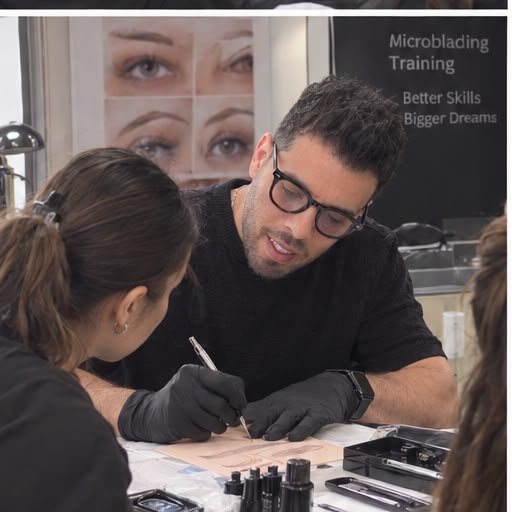
If you are asking how to become a permanent makeup artist in Jordan, the first thing I tell you is that the needle is not the hardest part of the craft. The hardest part is measuring and drawing before any incision, and knowing when to turn a case down. This page explains how I train at the Alaa Al Masri studio in Abdoun, Amman, what you learn, what the microblading course costs, and what it does not include.
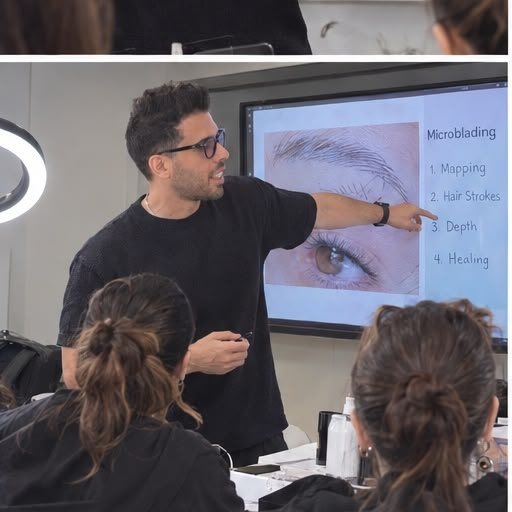
What do you need to master?
- Measuring with a caliper. A brow is measured in millimetres, not by eye: where the head starts, where the arch sits, where the tail ends. That is the difference between two matching brows and two brows that are "close".
- Precise drawing before the needle. Building the shape on the face and reviewing it with the client before any incision. The drawing is the decision and the needle is the execution, and what beginners get wrong most is not the hand but the drawing.
- Mixing colours. How pigment is built for each skin tone and hair colour, and why no single ready-made pigment suits everyone.
- Colour correction. Reading a colour that has turned blue or red, understanding why, and preventing it before it happens. I wrote about it here: my brow turned blue or red.
- Incision angle and depth. They decide whether a stroke stays a stroke or spreads into a blot after a few months.
- Reading skin. Knowing when to refuse a case. For example, microblading does not suit oily skin, and I explained why in is microblading right for oily skin?
How I train
I train one to one or in very small groups: either you alone with me or a very few people, so there is no class to watch from the back and no long wait for your turn. The training is on real sessions: it does not stop at artificial skin, it stops when you draw on a face and the result holds. What is explained on the board in the morning is carried out on a real case afterwards, and for your first stroke I watch the angle while you draw, not after.
I have worked with these techniques since 2013. I trained in Ukraine, Serbia and Vietnam, and I still travel to Vietnam every year. I train on what I use every day in the studio.
The eight techniques I train on
| Technique | What you practise |
|---|---|
| Fiber technique | Strokes drawn one by one, each in the direction of natural hair growth |
| Microblading | Hand drawing with a blade: incision angle, depth and direction, and when the technique does not suit at all |
| Nanoblading | The same stroke with a nano needle instead of a blade: machine setup, speed, and building the stroke without saturating it |
| Micropigmentation | Drawing fine hairs with a machine, without an incision |
| Powder brows | Fine dots set tightly together: how they are built, and why powder is the first choice for very oily skin and for a brow with no hair |
| Brow removal | Lightening and removing previous work, and reading colours that have turned blue or red before correcting |
| Lip blush | Evening out lip colour and softly defining the edges, choosing pigment by the natural lip colour |
| Permanent eyeliner | Work near the lash line: safety first, then line thickness and length |
The microblading course: length and fee
| Length | 5 days, theory and practice |
|---|---|
| Fee | 750 Jordanian dinars |
| Includes | The full training, and training tools |
| Does not include | A full toolkit for professional work after the course |
Fees and durations for the other techniques vary by technique and by what you actually need: someone starting from zero is not like someone who wants to master one technique. Message me on WhatsApp and I will give you the number directly. There are no fixed dates: the time is agreed to suit you.
Who are the courses for?
Hairdressers and makeup artists who want to add permanent makeup to their services, and anyone already practising who wants a new technique or to fix their foundations. You do not need to have started: I begin from zero when needed.
After the course: your first ten cases
The hardest part of the beginning is not learning but the first ten cases on your own. That is why I keep a private group for graduates: you send your first cases and I review them with you.
Coming from outside Jordan?
I receive trainees from Saudi Arabia, the UAE, Kuwait, Qatar, Bahrain and Oman. Message me on WhatsApp before booking flights: we agree the technique and the date first, then you book, because numbers are limited and dates are booked in advance.
How do you start?
Message me on WhatsApp at +962797373015 and tell me which technique you have in mind and where you are coming from, and I will reply with the details. The studio is in Abdoun, Queen Zein Al Sharaf Street, Amman, open every day from 10:00 to 19:00. Everything is on the courses page.
Have a question about your own brows?
A consultation settles which technique suits your skin and your face — no general rule fits everyone.